Website Development, AI & SEO Agency
London: 116 Cavell Street, E1 2JA · Dhaka: Rd #24, H #10, Rupnagar, Mirpur-1216

Menu
Website planning · Cost guide
Website Cost Breakdown: Design, Development, Hosting and Ongoing Fees
By Shaiful Mozumder · Published 11 November 2026
Most website quotes arrive as one number. One supplier says $3,000, another says $9,000, and neither shows what is inside the price, so you end up comparing totals that cover different work. A website cost breakdown fixes that: it splits the price into the one-off build and the bills that keep arriving after launch.
This guide goes line by line through design, development, content, domain, hosting, security, software and maintenance, with cited ranges in USD and GBP for each. It sits beneath our guide on how to plan a business website, which covers goals, pages, timeline and platform choice; here the focus is only on where the money goes.
Key takeaways
- A website has two kinds of cost: a one-off build (design, development, content, launch) and recurring fees (domain, hosting, security, software, maintenance).
- Design, features and content drive most of the build price; a booking system or online store can cost more than the design itself.
- Running costs for a small site can be low, but managed hosting, paid plugins and a maintenance plan can turn them into a four-figure annual bill.
- An SSL certificate does not need to cost anything: free certificates are widely available and many hosts include one.
- Compare quotes on the total for the first two or three years, not the launch price, and ask every supplier to itemise.
What goes into the cost of a website?
The cost of a website is the one-off build plus the recurring fees to keep it online, secure and up to date. The build is usually the larger single bill, but the recurring fees continue for as long as the site exists.
| Cost line | One-off or recurring | What it pays for |
|---|---|---|
| Design | One-off | Layout, visual style, page templates, mobile design |
| Development and features | One-off | Building the pages, CMS set-up, forms, bookings, e-commerce, integrations |
| Content | One-off, then ongoing | Copywriting, photography, product descriptions |
| Launch and migration | One-off | Redirects, testing, moving an existing site |
| Domain | Recurring (annual) | The web address |
| Hosting | Recurring (monthly or annual) | The server that keeps the site online |
| SSL certificate | Recurring, often free | The padlock and encrypted connection |
| Platform, themes and plugins | Recurring | Subscriptions and licence renewals |
| Maintenance and support | Recurring | Updates, backups, security monitoring, small changes |
A quote that leaves a line out is not necessarily cheaper. It may mean you supply that part yourself, or that it will be billed later.
One-off build costs, line by line
The build covers everything needed to get the site live: design, development, content and launch. Published figures vary widely, so treat the ranges below as reference points, not prices.
Design
Design is the visual layer: layout, typography, colour and how each template works on a phone. WebFX’s 2026 pricing guide, based on a survey of 250 US marketing professionals, puts design style at about $2,000 to $5,000 for a basic look and $10,000 to $15,000 for an advanced one [1].
The main choice is between customising an existing theme and commissioning a fully custom design. A customised theme is quicker and cheaper; a custom design costs more but is built around your brand and your content rather than a demo layout.
Development and features
Development turns the design into working pages and connects the features the business needs. Features move the price more than page count. WebFX reports e-commerce functionality at $5,000 to $25,000 and CMS integration at $3,000 to $25,000, depending on complexity [1].
Most suppliers price development by time, so hourly rates explain much of the gap between quotes. Clutch’s 2026 pricing guide, drawn from its agency database, reports typical agency rates of $100 to $149 an hour [2]. For the UK, Startups.co.uk’s small business guide quotes £25 to £50 an hour for freelance web designers and £50 to £150 an hour for small agencies [3].
If you want to see how fixed-price packages compare with hourly quotes, our website pricing page lists packages from $499, with monthly care plans priced separately.
Content is the line most often missing from quotes. WebFX puts professional copywriting at $60 to $300 per page, with the lower figure typical of short e-commerce product pages [1]. Photography, video and translation are separate again.
Writing the text yourself saves money, but late content is one of the most common reasons launches slip. If you plan to write it, agree a deadline before design starts.
SEO and launch work
Basic technical set-up (page titles, a sitemap, redirects from old URLs) should be part of any professional build. Ongoing SEO is different: WebFX reports that bundling SEO with a web design project adds $2,000 to $10,000, scaling with the number of target keywords [1].
Professional tip: If you are replacing an existing site, ask for redirect mapping to be listed as its own line. Skipping it is cheap at launch and expensive afterwards, because old pages that rank in search lead to errors instead of the new pages.
Recurring costs: what you pay every year
Recurring costs are the domain, hosting, SSL, software subscriptions and maintenance. For a small brochure site they can be modest; for a store or a site with many paid plugins they add up quickly.
| Recurring cost | US range | UK range | Notes |
|---|---|---|---|
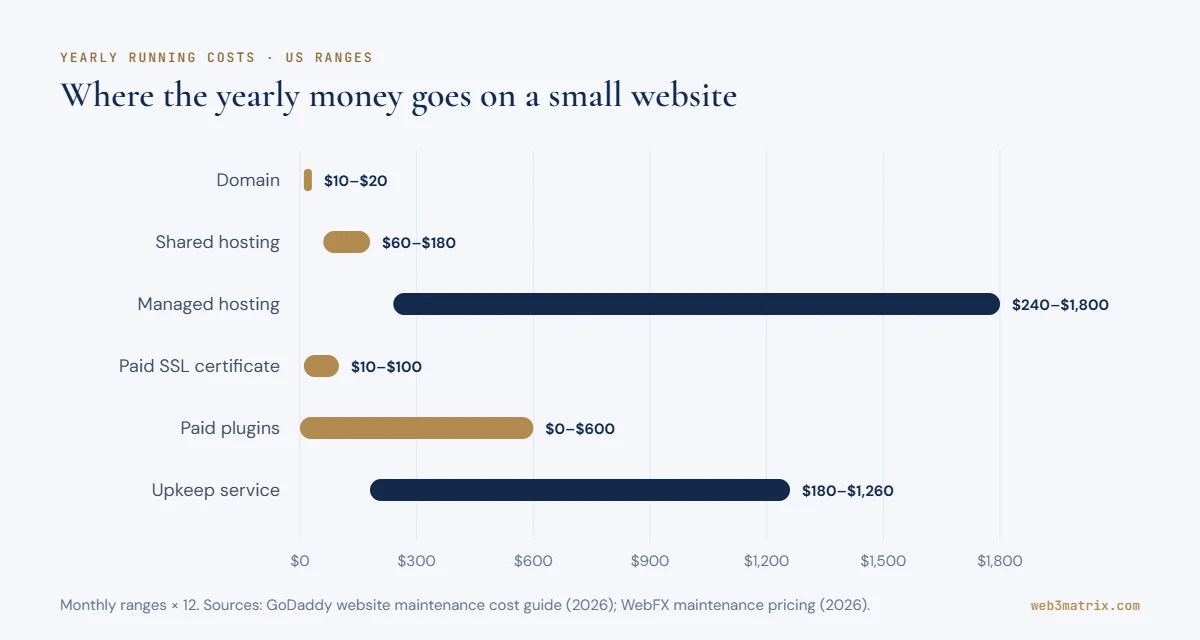
| Domain | $10 to $20+ a year [4] | £8 to £20+ a year [3] | Register it in your business’s name |
| Basic or shared hosting | $5 to $15 a month [4] | £5 to £30 a month on freelancer-built sites [8] | Fine for most small brochure sites |
| Managed hosting | $20 to $150+ a month [4] | £20 to £100 a month on agency-built sites [8] | Updates, backups and support handled by the host |
| SSL certificate | Free to $100 a year for standard certificates [4] | Free (Let’s Encrypt) or £50 to £200 a year [8] | Free certificates suit most small business sites |
| Plugins and apps | $0 to $50 a month [6] | £0 to £100+ a month [3] | Many premium plugins renew annually |
| Maintenance plan | $50 to $500 a month for a small to medium business site [4] | £50 to £150 a month (freelancer) or £100 to £500 (agency) [8] | Covers updates, backups, security and small edits |
Domain
A domain is an annual fee. GoDaddy’s 2026 maintenance guide puts typical domain costs at $10 to $20 or more a year [4], and Startups.co.uk gives £8 to £20 or more for UK businesses [3]. Some suppliers register the domain in their own name; avoid that, because whoever holds the account controls where your website and email point.
Professional tip: Put every renewal date for the domain, hosting, SSL certificate and paid plugins in one calendar, with a reminder a month before each. A lapsed domain or hosting renewal can take the whole website and email offline.
Hosting
Hosting is the server space that keeps the site online. GoDaddy lists shared hosting at $5 to $15 a month, VPS hosting at $20 to $80 and managed hosting at $20 to $150 or more [4]. Shared hosting is enough for many small brochure sites; managed hosting costs more but takes updates, backups and some security work off your hands.
Website builders and hosted e-commerce platforms bundle hosting into a subscription. Shopify’s Basic plan, for example, costs $29 a month billed yearly or $39 billed monthly, and online card payments on that plan are charged at 2.9% plus 30¢ per transaction in the US [7]. For a store, payment fees can outgrow every other running cost.
Professional tip: Ask every host for the renewal price as well as the introductory price. Introductory rates can apply to the first term only, and the renewal is the price you will keep paying.
SSL certificate
An SSL certificate encrypts the connection between visitors and your site. It does not have to cost anything: Let’s Encrypt issues trusted certificates at no cost to anyone who owns a domain [5], and many hosts install one automatically. Paid certificates run from about $10 to $100 a year for a standard certificate [4], and most small business sites do not need one.
Platform, themes and plugins
The WordPress software itself is free, but premium themes and plugins usually carry annual licences. WebFX puts plugin costs at $0 to $50 a month [6], and Startups.co.uk gives £0 to £100 or more a month for UK sites [3]. A typical small business site might use a premium form, backup or SEO plugin, and each renewal is easy to forget until it lapses.
Check the licence terms as well as the price. Akismet, a widely used anti-spam plugin, offers its Personal plan for personal sites and blogs, while professional or commercial sites are directed to its Pro plan at $9.95 a month, billed yearly [9]. A plugin that looks free on a hobby blog can become a paid line on a business site.
From our own site
When we rebuilt web3matrix.com on WordPress in October 2026, we kept paid licences to a minimum. The site runs on the free Hello Elementor theme, the free edition of the Elementor page builder and WPCode Lite. Where we needed something those tools did not offer, such as the blog post layout and the share bar, we added short code snippets through WPCode instead of buying another plugin, so there are fewer licences to renew each year. The trade-off is that someone has to maintain that code, which is part of what a maintenance plan pays for.
Maintenance covers software updates, backups, security monitoring and small content changes. GoDaddy’s 2026 guide puts maintenance for a small to medium business site at $50 to $500 a month, or $600 to $6,000 a year [4]. WebFX lists general website upkeep at $15 to $105 a month [6]. For the UK, ExpertSure’s 2026 price guide puts maintenance retainers at £50 to £150 a month for freelancer-built sites and £100 to £500 a month for agency-built ones [8].
The range is wide because “maintenance” can mean anything from automatic updates to a monthly allowance of developer time. Ask what is included, how quickly problems are fixed and whether content edits count against the plan.
Estimate your annual running costs
Use the estimator to see how hosting, security, plugin and upkeep choices change the yearly bill. It adds a standard domain to every option.
Interactive estimate
Annual running-cost estimator
Pick the options closest to your plan. Ranges use the cited US figures in this guide.
Estimated running costs
–per year, including a $10–$20 domain
–over three years
Excludes payment fees, content, marketing and developer time for changes. UK guide figures: domain £8–£20+ and non-builder hosting £20–£300+ a year. Ranges are reference points from the sources listed below, not quotes.
How to compare two quotes with a cost breakdown
Put each quote into the same table, one row per cost line, and fill in what each supplier includes. Gaps become obvious: one quote may include copywriting and hosting, while the cheaper one assumes you write the content and arrange hosting yourself.
Then add the recurring costs for two or three years. A quote with a lower build price and an expensive, mandatory hosting and maintenance plan can cost more over three years than a higher build price with modest running costs.
Hypothetical example: a five-page service business site. Using the low ends of the ranges above, a year of running costs could be about $250 (a $10 domain, $60 of shared hosting, a free SSL certificate, no paid plugins and $180 of basic upkeep). Using the high ends (a $20 domain, managed hosting at $150 a month, a $100 certificate, $50 a month in plugins and $105 a month in upkeep) the same site costs about $3,780 a year to run. Same website, a fifteen-fold difference in running costs, depending entirely on choices made at build time.
web3matrix.com
Drag to pan · Ctrl + scroll or pinch to zoom · ⤢ for full screenweb3matrix.com
Text version of this workflow
- Quote received — One total price or a list
- Split the costs — One-off build costs; Recurring yearly fees
- Check every line — Design, development, content; Domain, hosting, SSL; Plugins, maintenance
- Anything missing or unclear?
- Add running costs — Total for 2–3 years
- Compare quotes — Same lines, same period; Note exclusions
- Confirm in writing — Domain and hosting in your name; What maintenance covers
- Choose a supplier — Ask for a demo if unsure
“Price is what you pay; value is what you get.”
Questions to ask about any website quote
- Which of the cost lines in this breakdown are included, and which will I supply or pay for separately?
- Is the price fixed, or an estimate based on hours? What happens if the scope changes?
- Who registers the domain and hosting, and in whose name?
- What does the maintenance plan cover, and is it optional?
- Which themes, plugins or apps need paid renewals, and what do they cost each year?
- Is copywriting included? How many pages, and how many rounds of edits?
- Are redirects, testing and launch support included?
- What will it cost to make changes after launch?
Try this AI prompt
Here is a website quote: [paste the quote]. Split it into one-off build costs and recurring yearly costs. Then check it against this list: design, development, content and copywriting, launch and redirects, domain, hosting, SSL certificate, platform or plugin licences, and maintenance. For each item, say whether it is included, excluded or unclear, and list the questions I should ask the supplier. Do not estimate or invent prices.
Works in ChatGPT, Claude, Gemini or Copilot. Treat the answer as a first draft and check every figure and date before you rely on it.
Common website budgeting mistakes
Comparing launch prices only. It happens because the build is the biggest single bill. The result is a site that is cheap to build and expensive to run. Fix it by comparing two- or three-year totals.
Paying for an SSL certificate you do not need. Some packages add a paid certificate by default. Most small business sites can use a free certificate [5]; ask your host whether one is already included.
Letting the supplier own the domain. It is convenient at the start and a problem later, because moving supplier then depends on their cooperation. Register the domain in your business’s name and keep the login.
Forgetting plugin and app renewals. Licences bought at launch often renew a year later at full price. List every paid plugin and its renewal date in your budget.
Ignoring payment fees on an online store. Per-transaction fees grow with sales [7]. Include them in your forecast before choosing a platform.
Frequently asked questions
Is $1,500 a good price for a website?
It can be, for a small template-based site with a few pages and no complex features, especially from a freelancer. For comparison, Startups.co.uk puts a basic UK website at around £300 to £1,000 [3], while WebFX’s US survey puts basic small business projects at about $6,500 to $15,000 [1]. Check what the $1,500 includes: copywriting, hosting, a domain and post-launch support are often extra.
How much does it cost to develop and host a website?
Development is a one-off cost that ranges from a few hundred pounds for a basic site [3] to tens of thousands of dollars for custom features such as e-commerce [1]. Hosting is separate and recurring: about $5 to $15 a month for shared hosting and $20 to $150 or more for managed hosting [4]. Website builders and platforms such as Shopify combine hosting into a monthly subscription [7].
How much does it typically cost to maintain a website?
GoDaddy’s 2026 guide puts maintenance for a small to medium business site at $50 to $500 a month [4]. The figure depends on whether you handle updates yourself, whether the site has a store or bookings, and how much developer time the plan includes.
How do I see how much a website costs?
Ask for an itemised quote that separates design, development, content, launch and each recurring fee, then compare quotes line by line. For a rough estimate before you ask for quotes, list your pages and features and price each line using published ranges like the ones in this guide.
Budgeting for the whole life of your website
A website budget has two parts: what it costs to build and what it costs to keep. Itemise both, compare quotes over two or three years, and own your domain and hosting accounts from the start. The cheapest-looking quote is only cheap if its running costs and exclusions are too.
For the bigger decisions that shape these costs, such as platform, timeline and who builds the site, go back to the full website planning guide. If you would like to see a design before you commit any budget, Web3matrix will build a free demo homepage around your business.
Written by Shaiful Mozumder, Founder, Senior Web Developer and SEO at Web3matrix, building websites for businesses since 2010.
Sources
- WebFX — Web Design Pricing: How Much Does Web Design Cost in 2026?
- Clutch — Web Design Company Pricing Guide 2026
- Startups.co.uk — How much does a website cost for a small business?
- GoDaddy — How much does it cost to maintain a website in 2026?
- Let’s Encrypt — About Let’s Encrypt
- WebFX — 2026 Website Maintenance Pricing: How Much Should You Pay?
- Shopify — Pricing
- ExpertSure — How Much Does a Website Cost UK 2026? Full Price Guide
- Akismet — Pricing
- Berkshire Hathaway — 2008 Letter to Shareholders